
AI in Dentistry
Figure 1. The Prompt
Please estimate the number of intellectually and developmentally disabled individuals who will require dental care in a hospital operating room annually in the state of Georgia. Please also estimate the number of operating blocks (5-8 hours in length) required to treat all individuals during the year. While completing these estimates, describe each specific step and any assumptions made that were used to calculate the estimate. Each assumption should be supported by a specifically cited source. When citing each source, identify the associated assumption, citation, and a specific quote with page number from the source supporting the assumption. Once the estimate is complete, critically evaluate your thinking and suggest weaknesses and strengths of your initial estimate. Use these critiques to develop a worst-case and best-case scenario. While estimating the worst-case and best-case scenarios, continue to describe specific steps and cite each source by identifying the associated assumption, providing a citation, and providing a specific quote and page number from the source supporting the assumption.
A new phenomenon is on the rise. As large language models (LLM) and new artificial intelligence (AI) tools continue to permeate our culture, I am seeing an increase in their use in all facets of life. One frequent use is to search for information about, and explanations of, complex or otherwise obscure concepts. The LLM does the research and the thinking, providing an apparently ready-made answer with minimal headache. Unfortunately, the ease with which these tools are used can be deceptive, and answers are not always as good as they may first appear.
With an uptick in dentists using LLMs to explore policy issues, I became interested in how different models compare when it comes to policy research and analysis. In recent months, Georgia Dental Association’s government affairs team has seen several different dentists use AI to educate themselves about policy issues. Not all approaches to AI are equal, and careless application of these tools could undermine the credibility of the user. Consider recent events in which high profile federal reports and the work of big-name consulting organizations have been called into question due to AI invented citations of nonexistent sources.1,2
Approaches
Dentistry is on the cusp of AI adoption. Dentists are open to the use of AI for some basic tasks, such as appointment scheduling, but they are less open to allowing AI input on treatment recommendations.3 Meanwhile, some AI tools are already equipped to make diagnosis code suggestions, assess surgical risk, and summarize patient histories.4 Ongoing research into the use of these tools suggests that they can be useful in reducing certain false positive results, but findings do not replace a need for human verification.5,6 Beyond the dental chair, some dentists are beginning to incorporate LLMs into research: They can be useful for literature review and similar tasks.7
In general, one should consider a few things when planning to use an AI tool. First, the LLM’s response will only be as good as the information it is fed.8 For generalist LLMs, information selection is a particularly vulnerable area when it comes to accuracy. Providing an LLM a complex task with broad instruction about how to accomplish the task may lead to unexpected results, including outright hallucinations produced by the tool. Overreliance and automation bias, users failing to critically evaluate the output of the tool, are also risks that must be taken into account.8 Different models may even apply a worldview different from the user when evaluating less data driven problems.9
Given that policy analyses, and related fact-finding efforts, often require nuanced judgment about individual information sources, AI could be expected to be especially prone to error in this realm. One study on the topic found that AI briefings could supplement, but not supplant, human analysis.10 [a]
In fact, the finding of the minor experiment at the heart of this article also shows that AI tools, ones currently available at no dollar cost to the average person, remain prone to error when complex questions require critical evaluation. More tailored tools may be more successful, but the average person typically reaches for the cheapest most accessible option first.
Testing the Reasoning of Freely Available AI Tools
I decided to give a policy analysis prompt to a set of AI tools, all of which are available to any user with a computer and an internet browser (Figure 1). Each tool was asked to solve a particularly challenging policy analysis problem, estimating the need for hospital-based care for intellectually and developmentally disabled individuals in Georgia. I provided the same prompt to each tool and recorded the results. Then I read each response with a critical eye. My final step was the development of my own analysis.
Starting with the positive elements- All models were quick and efficient. Most started writing immediately. Only Anthropic’s Claude Sonnet 5 applied a noticeable pause before answering the question, and even then, the model was plenty fast. Each model structured the problem in a reasonable way, with most adopting a step-by-step approach that began with the Georgia population and worked methodically through a series of steps to calculate the number of operating blocks needed (Table 1).
Note that in most cases the first 3 steps are the same: establish population estimate, cite a prevalence estimate, and then calculate an I/DD population estimate. All 3 steps are reasonable, matching first 3 steps in the human generated analysis below (Table 1). Differences between estimates arise immediately. No estimate, except the human analysis, used a 2026 population estimate.[b] One AI model attempted to, but it retrieved a number from a website, titled “Georgia Population 2026,” that references a 2024 census estimate.11 Another successfully pulled a census estimate for the state for 2025. The prompt included no specific instruction to use 2026, but given Georgia’s annual population growth, using census estimates for prior years seems a poor assumption to start one’s chain of reasoning.
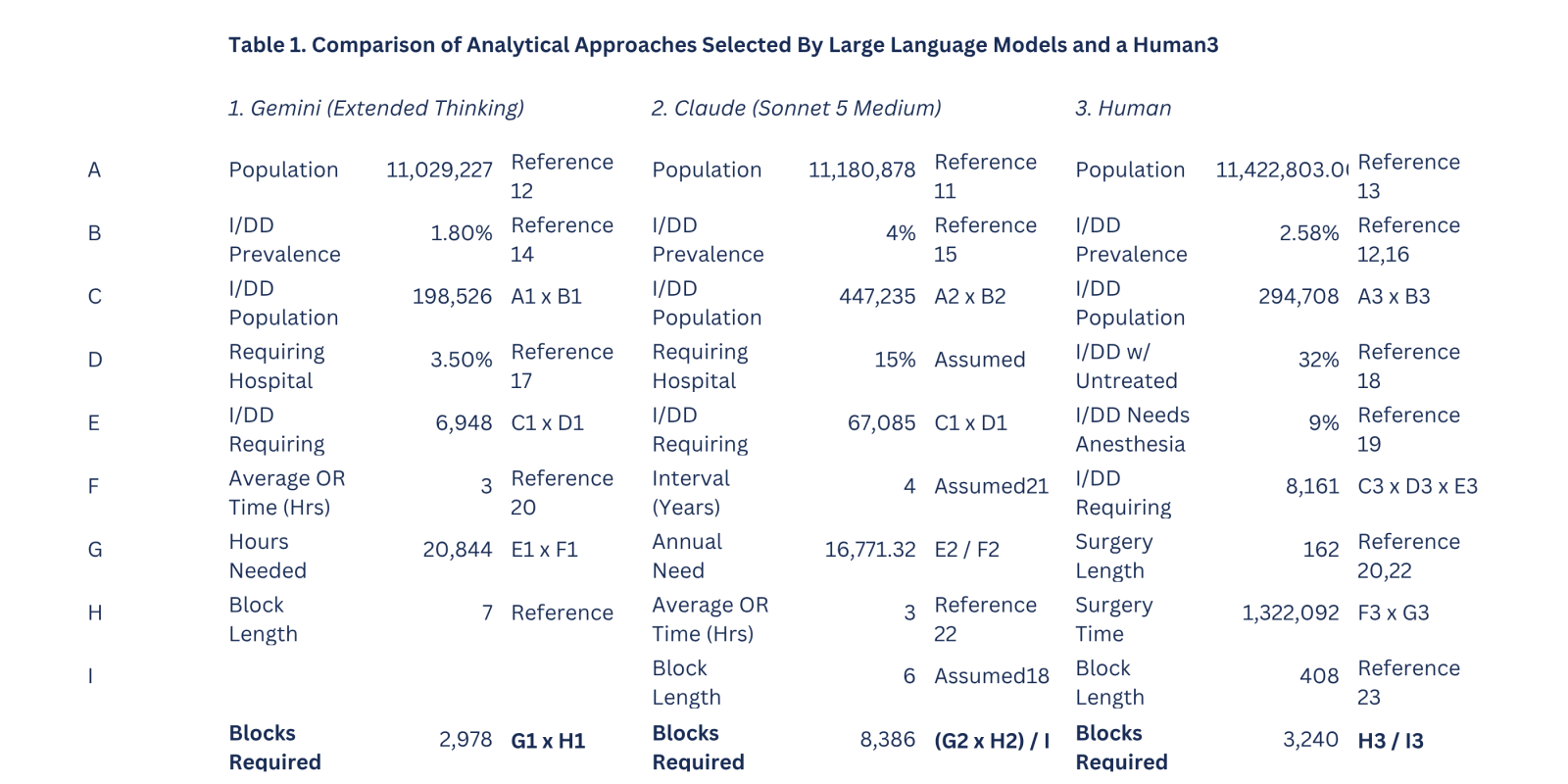
Estimates diverged following step 3. Several models elected to establish the need for hospitalization (Table 1). Most did this by making assumptions or selecting an inappropriate data point from a source. Claude reasoned that one source suggests that some, but not most, I/DD patients need general anesthesia for their dental care, and it created a bounded assumption of 10%-20% with a midpoint of 15%. It would go on to create a similar assumption about recall, that I/DD patients are only really seen every 4 years, in a later step.
The estimates converge again following the middle steps. Each model selected a series of sources and calculations to convert surgical time into block time. Even here, the AI models introduced added assumptions. In one case, an hour was added to the operating time observed in the cited reference to account for transition into and out of the operating room. I made a similar assumption for my estimate; however, the AI did not anchor its assumption with a citation. Another even used the wording of the prompt, a suggestion that a “block” could be considered 5-8 hours, to create its assumption. Several hallucinated sources popped up at this juncture as well.
These choices made by the LLMs are illustrative of the current vulnerabilities in these types of models. When unrestricted to a specified data set or unbounded by specified instructions, the model may come to conclusions that can be considered the human equivalent of an intuitive leap. As such, a user must review and evaluate each output, even going so far as to pull the cited sources and confirm the extracted data points. Notably, several of the sources used in my estimate matched sources identified by the LLMs, and the LLMs were extremely useful for finding relevant materials quickly.
Why This Matters to the Average Dentist
The ubiquity of LLMs means that dentists will discover an intersection between AI and their professional lives sooner or later. Not every dentist wants to engage in policy debates, but these debates, and how each debate is fashioned and framed, will affect them. In this example, the vulnerabilities of relying solely on the easiest to access LLM products should be obvious. Cited sources may not exist, or they may be used as the basis for a leap of faith a human analyst would steer away from. The model may choose numbers from sources that are dated or simply less than ideal. A dentist choosing to use an LLM to write a letter to a state representative or their member of congress should consider this.
These same vulnerabilities extend to the patients that are already seeking advice from these tools, and patient education based on sound scientific evidence will now be more important than ever.24,25 Incorporation of AI into people’s lives can be expected to continue apace, and every dentist needs to prepare for the ways in which we collect, share, and synthesize information will change.
References:
1. Hickman R. Trump administration “MAHA” health report cited nonexistent studies. Reuters. May 30, 2025. Accessed August 13, 2026. https://www.reuters.com/business/healthcare-pharmaceuticals/trump-administration-report-us-child-health-cited-nonexistent-studies-media-2025-05-30/
2. Paoli N. Deloitte was caught using AI in $290,000 report to help the Australian government crack down on welfare after a researcher flagged hallucinations. Fortune. October 7, 2025. Accessed August 13, 2026. https://fortune.com/2025/10/07/deloitte-ai-australia-government-report-hallucinations-technology-290000-refund/
3. Dentists Use AI to Make Appointments More Efficient, but Draw the Line at Clinical Decision Making. American Dental Association Health Policy Institute. July 2026. Accessed August 13, 2026. https://www.ada.org/resources/research/health-policy-institute/dental-practice-research/dentists-ai-usage-and-attitudes
4. Art for Clinicians. Epic. 2026. Accessed August 13, 2026. https://www.epic.com/software/art/
5. Patil S, Joda T, Soffe B, et al. Efficacy of artificial intelligence in the detection of periodontal bone loss and classification of periodontal diseases. The Journal of the American Dental Association. 2023;154(9):795-804.e1. doi:10.1016/j.adaj.2023.05.010
6. Farooqi OA, Fru GA, Gong YM, Oswald LE, DeNucci DJ. Evaluation of artificial intelligence–based clinical decision support systems for caries and periodontal bone loss. The Journal of the American Dental Association. 2026;157(6):611-618. doi:10.1016/j.adaj.2025.11.005
7. Emami M, Shirani M. Comparing the performance of ChatGPT, DeepSeek, and Gemini in systematic and umbrella review tasks over time. Journal of the American Dental Association. 2025;156(12):1014-1023.e9. doi:10.1016/j.adaj.2025.08.011
8. Schwendicke F, Sidhu SK, Ferracane JL, Tichy A, Jakubovics NS. Generative AI. JADA Foundational Science. Elsevier B.V. 2025;4. doi:10.1016/j.jfscie.2025.100056
9. AI models’ values are very different from most people’s They are more secular and more liberal—unless they’re made in China. The Economist. June 25, 2026. Accessed August 13, 2026. https://www.economist.com/briefing/2026/06/25/ai-models-values-are-very-different-from-most-peoples
10. Safaei M, Longo J. The End of the Policy Analyst? Testing the Capability of Artificial Intelligence to Generate Plausible, Persuasive, and Useful Policy Analysis. Digital Government: Research and Practice. 2024;5(1):1-35. doi:10.1145/3604570
11. U.S. States by Population (2024 Census Estimates, Updated 2026). 2026. Accessed August 13, 2026. https://uscanadainfo.com/top-us-states-by-population/
12. Annual Estimates of the Resident Population for the United States, Regions, States, District of Columbia, and Puerto Rico: April 1, 2020 to July 1, 2023 . 2023. Accessed August 13, 2026. https://www2.census.gov/programs-surveys/popest/tables/2020-2023/state/totals/NST-EST2023-POP.xlsx
13. State Residential Population, 2025-2060. Governor’s Office of Planning and Budget Population Projections. 2026. Accessed June 11, 2026. https://opb.georgia.gov/census-data/population-projections
14. Larson S, Neidorf J, Begin B, Pettingell S, Sowers M. Long-term supports and services for persons with intellectual or developmental disabilities: Status and trends through 2020. University Digital Conservancy. Published online 2024. Accessed August 13, 2026. https://conservancy.umn.edu/items/7878413a-2ba8-48f8-a1ce-046f1f004a8a
15. Understanding the IDD Community: Essential Data and Insights. Institute for Exceptional Care. 2026. Accessed August 13, 2026. https://www.ie-care.org/about-idd/
16. How many people have IDD? Institute on Community Integration Residential Information Systems Project. 2026. Accessed August 13, 2026. https://risp.umn.edu/products/key-questions/how-many-people-have-idd
17. Dougherty N. The dental patient with special needs: a review of indications for treatment under general anesthesia. Special Care in Dentistry. 2009;29(1):17-20. doi:10.1111/j.1754-4505.2008.00057.x
18. Access to Dental Services for Adults with Intellectual and Developmental Disabilities. 2025. Accessed August 13, 2026. https://www.macpac.gov/wp-content/uploads/2025/06/Access-to-Dental-Services-for-Adults-with-Intellectual-and-Developmental-Disabilities.pdf
19. Mac Giolla Phadraig C, Griffiths C, McCallion P, McCarron M, Donnelly‐Swift E, Nunn J. Pharmacological behaviour support for adults with intellectual disabilities: Frequency and predictors in a national cross‐sectional survey. Community Dent Oral Epidemiol. 2018;46(3):231-237. doi:10.1111/cdoe.12365
20. Mallineni SK, Yiu CKY. A Retrospective Audit of Dental Treatment Provided to Special Needs Patients under General Anesthesia During a Ten-Year Period. Journal of Clinical Pediatric Dentistry. 2018;42(2):155-160. doi:10.17796/1053-4628-42.2.13
21. Messieha Z. Risks of general anesthesia for the special needs dental patient. Special Care in Dentistry. 2009;29(1):21-25. doi:10.1111/j.1754-4505.2008.00058.x
22. Messieha Z, Ananda RC, Hoffman I, Hoffman W. Five year outcomes study of dental rehabilitation conducted under general anesthesia for special needs patients. Anesth Prog. 2007;54(4):170-174. doi:10.2344/0003-3006(2007)54[170:FYOSOD]2.0.CO;2
23. Interim HB 1146 Report: Dental Services - Survey and Regional Needs Assessment. 2024. Accessed August 13, 2026. https://dlslibrary.state.md.us/publications/Exec/MDH/HB1146Ch219(2023)_2023.pdf
24. Kreutziger M. Can You Trust AI for Dental Advice? To the Root. October 26, 2025. Accessed August 13, 2026. https://totherootdh.ca/can-you-trust-ai-for-dental-advice/
25. Maruska EE, Elgreatly A, Madaio W, Razoky K, Bay C, Mahrous A. Comparing dentist and chatbot answers to dental questions for quality and empathy. JADA Foundational Science. 2025;4:100044. doi:10.1016/j.jfscie.2025.100044
26. Binmogren R, Alshathri A, Alhamdan H, Alnuwaiser R, Aldosari M. Influence of disabilities on state‐level disparity in dental care utilization and tooth loss: Findings from the 2020 Behavioral Risk Factor Surveillance System. Special Care in Dentistry. 2024;44(3):925-936. doi:10.1111/scd.12944
[a] The model used in this context was OpenAI’s GPT-2. The estimate developed in this article used GPT-5.5, and GPT-5.6 was released not long after.
[b] At this point, I share with good natured humor that the GPT 5.5 promised a full report for download rather than citing its sources. Follow-up questions yielded promises of a 40-60 page report with a full reference list in APA citation. Further follow-up yielded an admission that at least one citation was, “intended as a proxy.” It then suggested using an actual paper, one looking at dental utilization among individuals with any kind of disability.26
[c] References were provided by each AI model. Efforts were made to check specific references for accuracy; however, several cited references were used by the AI to reason out assumptions. Except in the case of the human estimate, the numbers that are listed in the column may not reflect a direct quotation from the listed reference. If an entry lists the word reference without a citation, then the reference had not been located at the time of this writing.