The Dental Hygienist Shortage: A Critical Exploration of ADHA's Latest Advocacy Push
Recent white papers published by the American Dental Hygienists’ Association (ADHA) give insight into a legislative push that may be coming in 2027. The white papers arrive on the heels of The Dental Hygiene Modernization Act published by ADHA in September of 2025. If enacted, the legislation would grant hygienists meeting certain requirements, such as a bachelor’s degree and 2,000 hours of work experience in the last 3 years, the opportunity to practice independent of a dentist’s supervision. The model act is also designed to create independent hygiene boards and authorize the ownership of independent hygiene practices. Currently, no version of this legislation is being pushed in Georgia at this time.
The white papers seek to expand upon this premise, offering justification and exploration of an alternative world in which hygienists and dentists operate in separate spheres; however, a deeper look at the issue indicates that a policy path focused on radically boosting the supply of dental hygienists would better benefit the public.
Access to Care?
According to these papers, the promise of this new model is enhanced access to dental care and improved public health; however, they fail to give serious consideration to how these proposals duplicate existing infrastructure and distract from efforts that will better benefit the public. Throughout the discourse, the premise is that increasing levels of education and autonomy will enhance the quantity of quality preventative dental care available to the average person, or at least people in dental health professional shortage areas, but these policy aims fail to address the most significant root cause limiting access to preventative dental care, a lack of people able to legally do the work.
Georgia’s ability to train new hygienists has not increased in line with its pace of population growth. In fact, surveys by the Commission on Dental Accreditation (CODA) indicate that Georgia has lost educational capacity since 2018, and Health Resources and Services Administration (HRSA) projection models predict a national shortage of just over 24,000 hygienist full-time equivalents (FTE) in 2027 and a shortage of just over 33,000 in 2038. These may seem like small numbers against the backdrop of 343 million people in the United States, but projected demand is merely 191,000 FTE and some change. As such, the predicted shortage represents a missing 13%-17% of required capacity, and this does not even account for demand from people who would utilize dental care if their socioeconomic circumstances changed for the better.
Figure 1. HRSA Workforce Projections “What If?” Scenarios for Hygienists in the U.S.A.
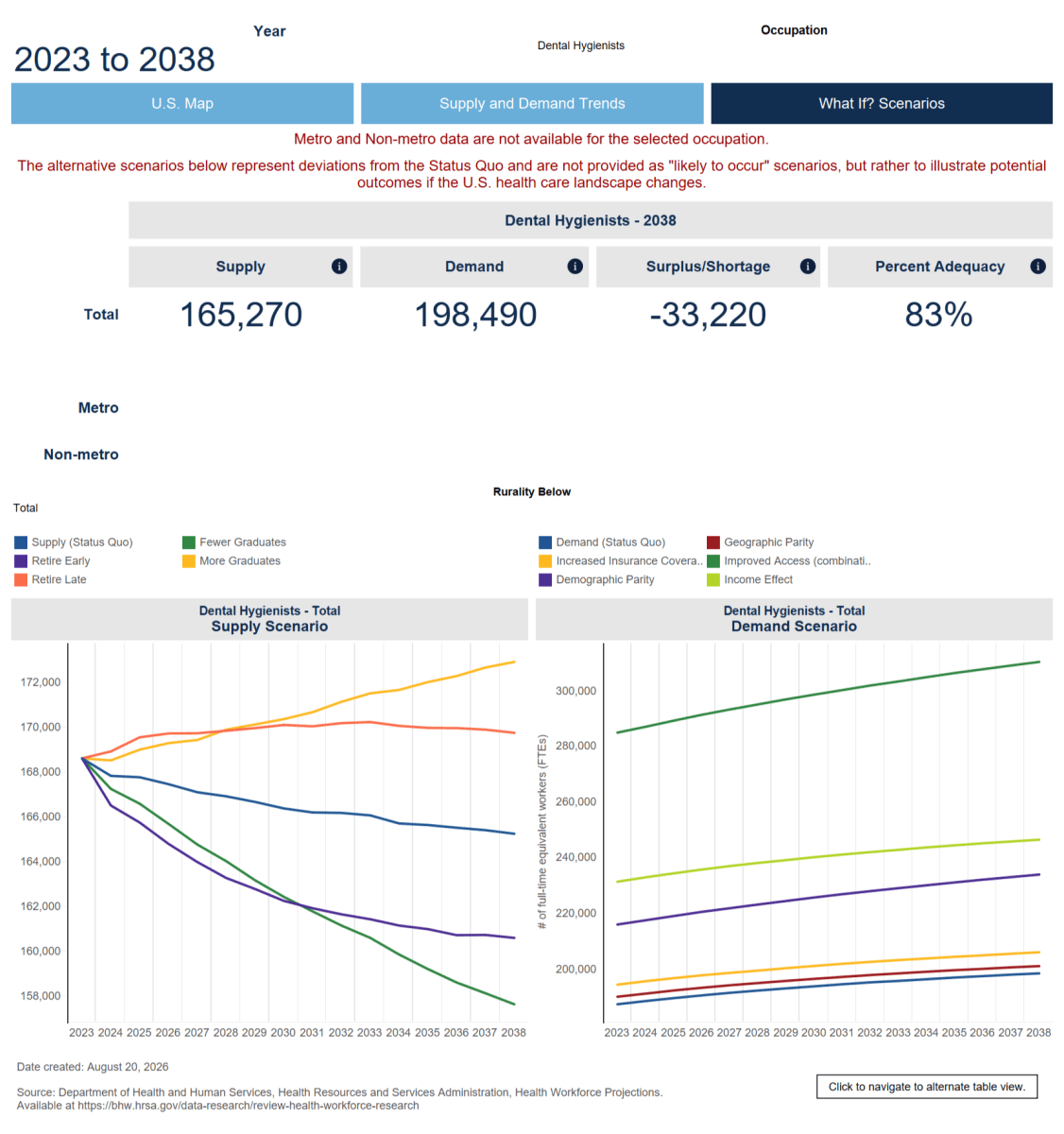
Notably, extending the careers of hygienists, the retire late scenario in HRSA’s prediction, does very little to address the shortage (Figure 1). It does alter the prediction from the status quo to level off supply, for a time, but demand continues to rise at a steady clip. With these trends in mind, questions arise about how independence could address this specific need, and the answer is that it would not.
After all, the reason for the limit on the growth of the number of hygienists is not lack of interest: It is a lack of training spots. Several states are turning to alternative workforce models to cope. These solutions include strategies that direct those with prior qualifying training into hygiene, like licensing internationally trained dentists as hygienists, and that upskill existing team members to take on tasks traditionally, though not necessarily justifiably, reserved for dental hygienists. Upskilling avenues typically have the additional benefit of reducing barriers to entry into the workforce by requiring a series of readily available, affordable, and structured trainings rather than a traditional degree program.
ADHA’s Arguments
Proponents of independence argue that it improves access to preventative dental care. Less attention is given to the mechanism behind this; one possible mechanism would be that if dental hygienists conceivably made different decisions about practice location than dentists, then distribution of preventative care might improve, or perhaps dental hygienists may be more amenable to seeing Medicaid patients. They also argue that economic incentives between independent hygienists and dentists employing hygienists differ, resulting in a different care mix depending on the type of service provider, and certain tasks may be substitutable. In other words, both dentists and hygienists may clean teeth or provide local anesthesia in most states, and that overlap, and limits on who can do what when, may affect prices and overall dental utilization.
The sources cited in the paper make all of this appear more conceptual than actual, the best focusing on variation in types of dental appointments as a measure of utilization, but high-quality studies on service mix and outcomes are hard to come by. The studies cited by ADHA’s paper tend to focus on the recent past. A 2024 study by Chen and others focused on the period between 2001-2014, discusses a period radically different from today’s dental landscape. One of the most notable differences between now and then is the way in which teledentistry is reshaping the delivery of dental hygiene, with hygienists more able than ever to practice in nontraditional settings without sacrificing the benefits of a dentist’s judgment and direct involvement in care.
Incentives for the dentist and the hygienist do not differ all that much. Each wants a recurring patient who receives enough benefit from their relationship with the dental practice to return, thus maximizing revenue over time by helping each patient to develop and maintain good oral health through routine preventative care and dedicated dentist oversight. Sites dedicated to all facets of the dental care continuum smooth friction points by centralizing services and pooling administrative burden. They also center all services around the delivery of preventative care with restorative services available when necessary. When people are unable to go directly to the dentist, the dental team can come to them, and many care models have been deployed to promote access to both preventative and restorative care. The best offer patients access to all of the care that they need.
The way in which Chen and others’ 2024 paper is cited is an example of an instance where ADHA’s white paper has adopted statements and arguments with rhetorical flourishes that imply the evidence is stronger than it is. Most informative is a direct quote from Chen et al., 2024:
These results raise the possibility that greater DH autonomy increases access to preventive care, which helps maintain good oral health and reduces the need for the treatment of dental disease. However, we do not find direct evidence of such an offset among the set of states that move to autonomy level 3 or 4 in these models, as neither the effect of greater autonomy on dental treatment in the level 3 states, nor the effect on preventive care visits in the level 4 states is statistically significant.
Level 3, collaborative practice, and Level 4, full independence, states are ones in which hygienists have the greatest degrees of independence and the least direct engagement with a dentist. Chen et al., 2024 go on to indicate that limited statistical power is a concern for parts of their analysis as are competing explanations such as increased federal funding for federally qualified health centers.
Chen et al., 2024 also includes a chart that emphasizes that the period between 2001-2014 involves the restructuring of supervision rules primarily in public health settings, specifically schools and public health agencies. As such, greater learning about access to care may come from considering these changes on a case-by-case basis rather than treating these policy adjustments as a single monolithic item.
In fact, their Table A6 is particularly interesting. The table focuses on a model examining the effect of autonomy level for individuals below 200% of the federal poverty line. In this model, movement to level 2, general supervision, significantly increases preventative visits for the target population. Movement to level 3 shows no significant changes, and moving to level 4 does not show a significant change in preventative visits, though overall visits go down a statistically significant amount. As such, this model suggests that general supervision appears to be the policy factor with the greatest payoff for advocates seeking to expand care to vulnerable populations, and other expansions of scope may have limited to no effect.
Strategic Value
Certain aspects of this conversation can inform future policy priorities in Georgia. Incentives matter when it comes to access to dental care, and both hygienists and dentists tend to be much more likely to locate in more urban areas. Policy structures and regulatory decisions can and do create barriers to dental care delivery, usually in the name of protecting quality of care. Often this cost is justifiable. Nobody wants an untrained or unlicensed person making permanent changes to their teeth, and people are willing to tolerate barriers to labor force entry, and a slight reduction in the number of individuals able to legally offer dentistry, to ensure their teeth continue to work after a visit to the dental clinic, but not all occupations need to be licensed.
Prioritizing policies that maximize the quantity of quality preventative dental care should be every state’s primary priority. That means training an adequate number of dental team members who can provide basic and advanced hygiene services. For most, this will require investment into public institutions and the development of public-private partnerships. Others are exploring methods of lowering the barrier to entry for certain tasks. When it comes to maldistribution, states can also step in when the private market fails, by providing public health access points or adequately subsidizing and providing quality dental coverage for those unable to acquire it themselves. Time will tell whether these approaches bear fruit, but policymakers should not presume that independent practice for dental hygienists will automatically solve hard problems created by existing constraints on the supply of preventative dental care.